
EU Road Trip With Your Dog Everything You Need to Know Now
A practical guide for road tripping across Europe with your dog
There is something deeply comforting about traveling with your dog in your own car.
Your dog is family. Keeping them close simply feels right.
Your dog curls up in the back seat. The engine hums softly. You know exactly where their blanket is. You control the temperature. You choose when to stop. There is no cargo hold, no baggage tag, no stranger deciding whether your dog is “too big.”
Driving across the European Union with your dog in 2026 is still one of the most beautiful ways to travel together. Yes, the paperwork matters. Yes, safety rules are stricter than they used to be. But once you understand the structure, it becomes simple.
This guide is not just about compliance.
It is about comfort.
It is about freedom.
It is about building memories on the road with your own car and your best friend beside you.
Let’s go step by step.
1. Why Driving Your Own Car Is the Best Way to Travel with Your Dog
When people talk about traveling with dogs in Europe, they often compare options: plane, train, bus, ferry.
But here is the truth.
Your own car wins.
No Weight Limits. No Surprises.
On planes, your dog might be denied boarding if paperwork has a small mistake. On trains, large dogs often need muzzles. On buses, most companies simply refuse dogs entirely.
In your own vehicle:
- There are no weight limits.
- There are no breed restrictions imposed by transport providers.
- There are no strangers deciding whether your dog is “too much.”
Your car is your moving home.
Your Dog Feels the Difference
Dogs are creatures of routine. They recognize:
- The smell of your seats.
- The rhythm of your engine.
- The way sunlight falls through your windows.
Even anxious dogs tend to settle faster in their own family vehicle than in public transport.
When you drive:
- You choose the music.
- You control the stops.
- You adjust for your dog’s mood.
That control makes everything calmer.
2. The 2026 Legal Toolkit: Calm, Organized, and Ready
Let’s talk paperwork but in a practical, non-stressful way.
Border crossings inside the EU are generally smooth, but pet documentation is harmonized and digitally traceable in 2026. That means: everything must be correct.
Not complicated. Just correct.
🐾 The EU Pet Passport: What You Really Need to Know in 2026
If you live in the EU and you’re planning a road trip with your dog, the EU Pet Passport is your foundation. It’s the document that allows your dog to travel between EU countries without quarantine, as long as everything is correctly recorded and up to date.
Think of it as your dog’s official travel identity.
You can read the official EU guidance here:
https://europa.eu/youreurope/citizens/travel/carry/pets-and-other-animals/index_en.htm
What the EU Pet Passport Includes
When properly issued by an authorised veterinarian, your dog’s passport contains:
• Microchip identification (ISO compliant)
• Rabies vaccination record
• Veterinarian details and official stamp
• Optional clinical or health notes
The passport is valid for life, as long as rabies vaccinations are kept current without interruption.
The Two Rules You Cannot Ignore
1️⃣ Microchip First, Vaccine Second
Your dog must be microchipped before receiving the rabies vaccination.
The rabies vaccine is only valid for travel if it was administered after the microchip was implanted. If the order is reversed, the vaccine may not count legally for border control.
This is one of the most common mistakes people make.
If you want additional confirmation from French authorities, you can consult:
https://www.douane.gouv.fr/fiche/travel-coming-france-your-pet
2️⃣ The 21-Day Waiting Period
If your dog receives their first ever rabies vaccine (primary vaccination), you must wait 21 days before traveling.
This waiting period does not apply to booster vaccines, as long as there has been no lapse between doses.
If a rabies vaccination expires and is not renewed in time, your dog may have to restart the process and wait 21 days again.
Simple practical rule:
Check your dog’s passport at least one month before travel, not the night before departure.
Extra Requirements in Some Countries (Worm Treatment)
While most EU countries only require microchip + rabies compliance, a few destinations require an additional tapeworm treatment before entry.
This is especially important if you are traveling to:
• Ireland
• Finland
• Malta
• Northern Ireland
• Norway
These countries require treatment against Echinococcus multilocularis (a specific tapeworm) between 24 and 120 hours (1–5 days) before arrival.
The treatment must:
• Be administered by a licensed veterinarian
• Be recorded in the pet passport
• Include the product name
• Include the date and exact time
• Include vet signature and stamp
If this is missing, your dog can legally be refused entry.
Official UK guidance (very clear and practical):
https://www.gov.uk/taking-your-pet-abroad/tapeworm-treatment-for-dogs
Even if you’re not entering the UK, this page explains the timing clearly.
🇬🇧 Driving from the UK into the EU with Your Dog (2026 Guide)
If you are travelling from the United Kingdom into the European Union by ferry or Eurotunnel, your dog cannot use an EU Pet Passport issued in Great Britain.
Instead, you must travel with an Animal Health Certificate (AHC).
This certificate replaces the EU Pet Passport for entry into the EU from Great Britain.
Official UK government guidance:
https://www.gov.uk/taking-your-pet-abroad
What Is an Animal Health Certificate (AHC)?
An Animal Health Certificate is an official veterinary document confirming that:
• Your dog is microchipped
• Your dog has a valid rabies vaccination
• Your dog meets EU health entry requirements
• You are travelling for non-commercial purposes
The certificate must be issued by an Official Veterinarian (OV) in the UK.
You can find more information about what it includes here:
https://www.gov.uk/taking-your-pet-abroad/getting-an-animal-health-certificate
Timing Is Critical
There are strict timing rules.
1️⃣ Issued Within 10 Days Before Entry
The AHC must be issued no more than 10 days before your arrival in the EU.
That means:
If you plan to board the ferry or Eurotunnel on July 15, your AHC must be dated July 5 or later.
If it is issued too early, it becomes invalid.
2️⃣ Valid for 4 Months Inside the EU
Once you enter the EU, the AHC remains valid for:
• 4 months of onward travel within EU countries
• Or until the rabies vaccination expires (whichever comes first)
This means you can travel across multiple EU countries during one trip using the same certificate.
3️⃣ Single Use for Entry
This is extremely important.
The AHC is single-use for entry into the EU.
If you:
• Return to the UK
• Then later want to re-enter the EU
You must obtain a new Animal Health Certificate.
It cannot be reused for multiple UK → EU entries.
Rabies Requirements Still Apply
Your dog must:
• Be microchipped before the rabies vaccination
• Have a valid rabies vaccine
• Wait 21 days after a primary rabies vaccination before travel
If the rabies vaccination has lapsed, you must restart the process and wait 21 days again.
Full explanation from the UK government:
https://www.gov.uk/taking-your-pet-abroad/rabies-vaccination-boosters-and-blood-tests
Tapeworm Treatment (When Returning to the UK)
While the EU does not generally require tapeworm treatment for entry from the UK, the UK requires tapeworm treatment when returning with your dog from most EU countries.
This treatment must be:
• Administered by a vet
• Given between 24 and 120 hours (1–5 days) before returning to the UK
• Recorded in the certificate
Official UK guidance on tapeworm treatment:
https://www.gov.uk/taking-your-pet-abroad/tapeworm-treatment-for-dogs
Failing to meet this requirement can result in delays or quarantine on return.
Where Checks Happen
When entering the EU from the UK, your pet’s documents are checked at:
• Ferry ports
• Eurotunnel terminals
• Designated Traveller Points of Entry
The European Commission explains the entry process here:
https://europa.eu/youreurope/citizens/travel/carry/pets-and-other-animals/index_en.htm
Practical Advice for UK Drivers
• Book your vet appointment early, especially in summer.
• Confirm your vet is an Official Veterinarian authorised to issue AHCs.
• Check rabies dates at least one month before travel.
• Keep both physical documents and digital photos on your phone.
• Carry your dog’s microchip number separately in case scanning is needed.
Summer appointments for AHCs fill up quickly, particularly before school holidays.
Northern Ireland Exception
If your dog has a valid EU Pet Passport issued in Northern Ireland, different rules may apply due to specific agreements.
Check current guidance here:
https://www.daera-ni.gov.uk/articles/travelling-pets
Because regulations can evolve, always verify requirements a few weeks before departure.
Driving from the UK into the EU with your dog is very manageable once you understand the timing rules.
The key is simple:
✔ Microchip
✔ Rabies valid
✔ AHC issued within 10 days
✔ New certificate for every new UK → EU entry
Plan calmly, book early, and your road trip can begin without stress.
3. Securing Your Dog in the Car: Safety Is Love
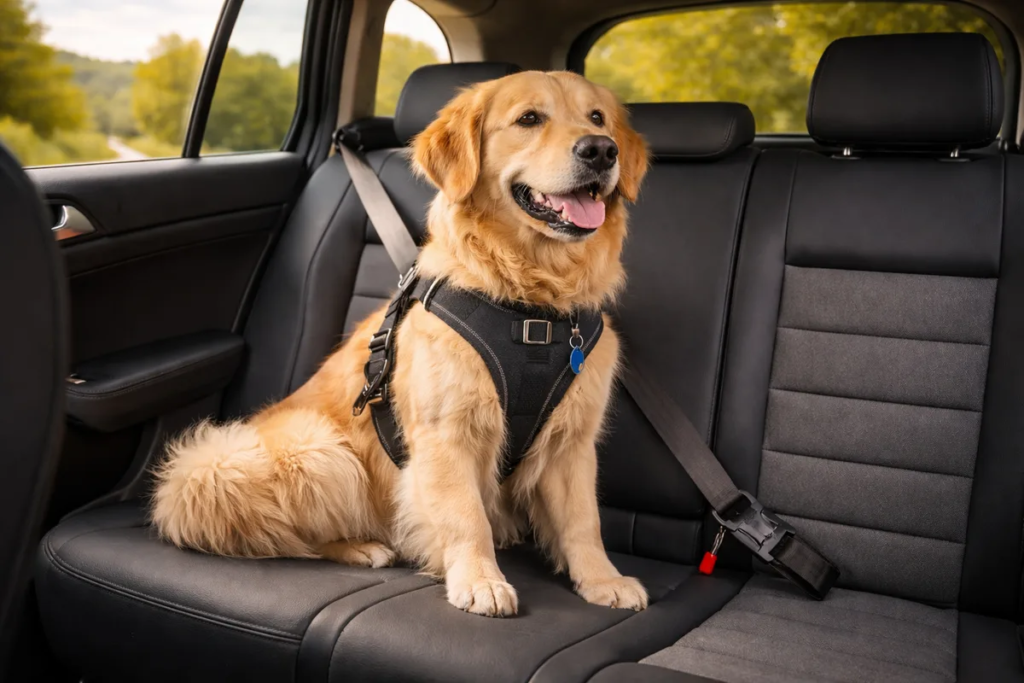
Here is where 2026 enforcement is stricter than many people realize.
Across countries like Germany, Spain, and Austria, an unsecured dog is legally considered an unsecured load.
In case of accident:
- You can receive fines.
- Insurance coverage may be reduced.
- Your dog can be seriously injured.
This is not about bureaucracy.
It is physics.
A 30 kg dog in a 50 km/h collision becomes a projectile.
Three Safe Options
1. Crash-Tested Harness
Best for:
- Dogs who prefer the back seat.
- Medium-sized breeds.
- Dogs that like seeing you.
Make sure:
- It is crash-tested.
- It attaches to the seat belt system properly.
- It fits snugly.
A simple leash clipped to a headrest is not enough.
2. Fixed Boot Crate
Best for:
- Large breeds.
- Anxious dogs who feel safer enclosed.
- Long highway drives.
The crate must:
- Be secured to anchor points.
- Not slide.
- Allow ventilation.
A stable crate can actually lower anxiety dramatically.
3. Cargo Barrier (Dog Guard)
Best for:
- Estate cars.
- SUVs.
- Multiple dogs.
Choose:
- Steel mesh.
- Properly installed system.
Avoid flimsy pressure-fit plastic barriers.
4. Planning Your Route: The 3-Hour Rhythm
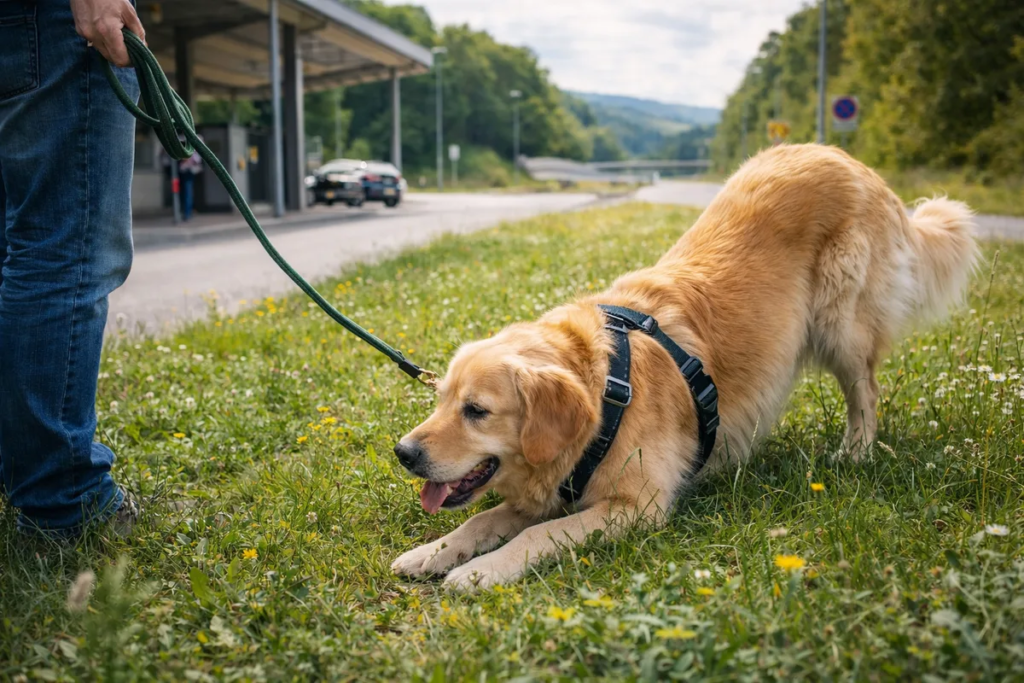
Long drives are not about speed. They are about rhythm.
In 2026, animal welfare recommendations across Europe encourage regular breaks.
The “3-hour pulse” works beautifully.
The 3-Hour Pulse: A Simple, Humane Structure
A practical rhythm for long EU road trips looks like this:
Every 2 to 3 hours, stop for:
• Fresh water
• Stretching and movement
• Sniffing and decompression
• A temperature check inside the vehicle
This simple structure prevents most common road-travel problems.
💧 Hydration: Small and Frequent
Do not wait until your dog looks thirsty.
Air conditioning dries the air. Long highway stretches increase panting. Stress increases fluid loss.
Offer small amounts of water every 2–3 hours instead of one large portion.
Why small portions?
• It reduces nausea
• It prevents overfilling the stomach
• It lowers the risk of vomiting in motion
A collapsible travel bowl works well. Keep it accessible in the front seat area, not buried in the boot.
If you are traveling across countries with different water mineral content, consider mixing bottled or “home” water gradually to avoid stomach upset.
🐾 Movement: Circulation Matters
Even relaxed dogs become stiff after lying in one position for hours.
At each stop:
• Allow 5–15 minutes of walking
• Let your dog change pace naturally
• Avoid rushed bathroom breaks
Movement helps:
• Reset blood circulation
• Reduce muscle stiffness
• Lower restlessness later in the drive
For older dogs or large breeds, these stops are especially important.
🚗 Choosing Dog-Friendly Rest Stops Across the EU
Not all motorway rest areas are equal.
When planning your route, it helps to identify stops with green space.
Helpful planning tools:
BringFido (Europe-wide database of pet-friendly places)
https://www.bringfido.com
Park4Night (useful for finding quiet stops, green areas, and parking options across Europe)
https://park4night.com
In France, many motorway “Aires” include small green zones.
In Germany, look for “Hundewiese” or “Hundeaustlauf” areas near service stations.
Planning these stops in advance reduces stress during the drive.
🧠 Add Buffer Time to Your Route
If Google Maps says 8 hours, plan for 10.
Road travel with a dog should not feel rushed.
Add:
• Extra hydration stops
• Flexible lunch breaks
• Backup rest areas
The goal is not to “arrive fast.”
The goal is to arrive calm.
🐕 For Puppies, Seniors, or Anxious Dogs
Adjust the rhythm.
• Puppies may need breaks every 1–2 hours.
• Senior dogs may require more frequent movement.
• Anxious dogs benefit from predictable stopping intervals.
If your dog is new to long drives, build up gradually before your cross-border trip:
• 30 minutes
• 1 hour
• 2 hours
Create positive associations before attempting a full-day journey.
5. Temperature Awareness
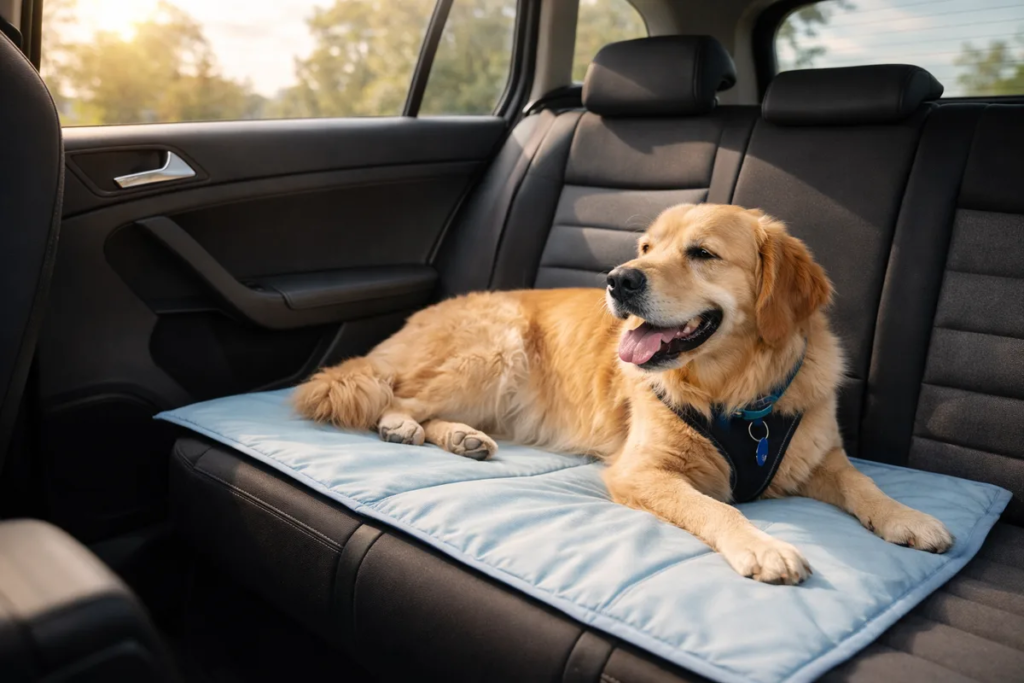
Even in mild climates, cars heat quickly.
Many EU countries now allow bystanders to intervene if a dog is visibly in distress inside a vehicle.
Golden rule:
Never leave your dog alone in a parked car above 20°C.
Even five minutes can become dangerous.
Cooling Support
If traveling in southern Europe:
- Use reflective windshield covers.
- Park in shade.
- Use a cooling mat.
- Ventilate before entry.
Electric vehicles with “Dog Mode” help but always leave a clear note on the window saying the AC is on.
People are alert. And that is a good thing.
6. The In-Car Dog Travel Kit: Comfort First
Keep your essentials accessible not buried in luggage.
Your road kit should include:
- EU Pet Passport (physical copy)
- Collar with international phone number (+country code)
- Spare leash
- Foldable water bowl
- Cooling mat
- First aid basics (antiseptic wipes, tweezers, styptic powder)
- Familiar blanket or worn t-shirt
That last one matters more than most people think.
Familiar scent reduces cortisol levels.
Your dog feels anchored.
7. When the Car Breaks Down: Simple Backup Plans That Actually Work
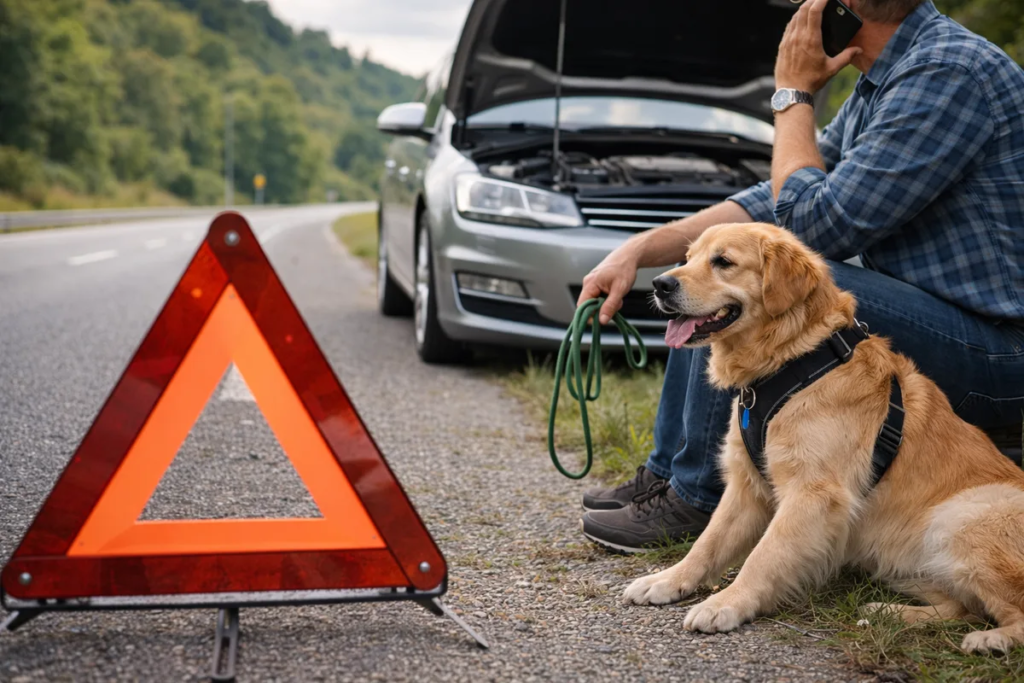
No one plans for a breakdown.
But if you are driving across the EU with your dog, especially in a foreign country, having a simple backup plan can prevent panic.
Let’s keep it realistic.
If your car stops working on the highway:
• Most long-distance buses do not accept dogs
• Large dogs on trains often need a muzzle and a half-price ticket
• Regular taxis may refuse animals
So what can you do instead?
Roadside Assistance: Call First, Decide Later
Before you even leave home, make sure you know:
• Your insurance roadside assistance number
• Whether your policy includes towing across borders
• Whether they can transport pets with you
In Europe, many major roadside services allow pets to remain with the owner during towing or transport but not all.
If you rent a car, check the rental agreement for cross-border breakdown coverage.
Save the emergency number in your phone and write it down on paper.
In stressful situations, batteries die.
Uber Pets and Ride Apps (The Easiest Urban Backup)
In many European cities, Uber Pet is available.
This allows you to request a driver who accepts animals.
You simply select the “Uber Pet” option in the app (where available).
It operates in cities across countries like:
• France
• Germany
• Spain
• Italy
• Netherlands
• UK
Search for “Uber Pet” in your city before traveling so you know if it’s available.
If Uber Pet is not available, message the driver immediately after booking and politely ask if they accept dogs. Many do, especially if the dog is calm and secured.
Train as a Backup (Know the Basics)
If you absolutely must use a train:
Most major European rail companies allow dogs, but rules vary.
General pattern across Europe:
• Small dogs travel free in a carrier
• Large dogs need a half-price ticket
• A muzzle may be required
Examples:
SNCF (France):
https://www.sncf.com/en/passenger-offer/travel-with-your-pet
Deutsche Bahn (Germany):
https://www.bahn.com/en/offers/regional/travelling-with-dogs
Renfe (Spain):
https://www.renfe.com
Even if your dog never wears a muzzle normally, carrying a soft fabric muzzle in your emergency kit is smart. You may never use it but if you need a train unexpectedly, you won’t be refused boarding.
Pet-Friendly Hotels: Your Overnight Safety Net
If your car breaks down late in the day, the safest solution may be:
Stay overnight.
Before your trip, bookmark hotel platforms with pet filters:
Booking.com (filter “Pets Allowed”):
https://www.booking.com
BringFido (dog-specific database):
https://www.bringfido.com
Save 2–3 hotel options along your planned route before departure. That way, if something happens, you already know safe places nearby.
Language Barrier? Keep It Simple
If you are traveling in a country where you don’t speak the language, prepare one simple sentence saved on your phone:
“My car broke down. I am traveling with my dog. Is this allowed?”
Translate it into the local language using Google Translate offline mode.
Download offline language packs before departure:
https://translate.google.com
Keep it practical. Short sentences work best.
The Emergency Comfort Kit
If you are stuck waiting for a tow truck:
Make sure you can access:
• Water
• A leash
• A waste bag
• A small snack
• Your dog’s blanket
Even a calm dog becomes anxious if they sense your stress.
Your calm voice matters more than anything.
The Simple Backup Plan (That Covers 90% of Situations)
Before departure, make sure you have:
✔ Roadside assistance number saved
✔ Uber app installed
✔ Soft muzzle packed
✔ Hotel app bookmarked
✔ Offline maps downloaded
That’s it.
No complex planning needed.
8. Making the Drive Beautiful
Driving across the EU with your dog is not just logistics.
It is:
- Sunrise over the Alps.
- A rest stop in Provence.
- A forest break in Bavaria.
- A coastal breeze in Portugal.
Your dog will not remember the border crossing.
They will remember:
- Your calm voice.
- The rhythm of stops.
- The safety of your presence.
Slow down.
Add 20% more time to your schedule.
Make space for the unexpected picnic.
9. Crossing Borders Smoothly
Most internal EU borders are open.
But random checks happen.
When stopped:
- Stay calm.
- Present passport quickly.
- Keep dog secured.
Confidence and organization prevent delays.
10. Building a Positive Association with Road Travel
If your dog is not used to long drives:
Start weeks before.
- 10-minute trips.
- Then 30.
- Then 1 hour.
Reward calm behavior.
Avoid feeding a large meal immediately before departure.
Let them eliminate before highway stretches.
Gradual exposure prevents motion sickness and stress.
11. The Emotional Side of Traveling Together
Driving together is bonding.
You are choosing:
- To include your dog.
- To adapt your pace.
- To share the experience.
That matters.
Dogs read our stress.
If you are relaxed, they relax.
The journey becomes something shared.
12. Final Thoughts: Freedom, With Responsibility
Driving across the EU with your dog in 2026 is absolutely possible.
It requires:
- Correct paperwork.
- Proper restraint.
- Temperature awareness.
- Planned breaks.
But beyond the regulations, it is about something deeper.
It is about refusing to treat your dog as cargo.
It is about turning the highway into shared memory.
Your own car gives you:
- Flexibility.
- Control.
- Comfort.
- Safety.
And in the end, that is what makes the journey beautiful.
Take your time.
Check your documents.
Secure the harness.
Pack the blanket.
Then start the engine.
Your dog is ready.